

My Journey from Toxic Cult to Cultural Transformation
On a late summer night in 2008, I was confronted with a terrible truth I had desperately tried to escape.
I was watching a prime- time investigative program on Swedish television. While the image on the TV screen was blurred and the individual’s voice was distorted to protect her anonymity, I watched my own mother tell a national broadcast audience how she, as a member of a Christian community that gradually turned into a religious cult, became isolated and demonized, and even tried to take her own life as a way to escape from the terror and the trauma.
I grew up in that community, learned to revere its manipulative founder, and became part of its destructive culture, even as it tore our family apart.

Complicit in Psychological Abuse
I was raised in a family passionate about helping people in need. My mom was a social worker, and my dad was building a fledgling IT business.
At the age of eleven, our lives took a significant turn when my parents gave up city life to help establish a Christian church and community center in a small village. Guided by the inspiring vision of a charismatic founder to serve people’s needs holistically, the community grew and became the focal point of our family’s life. My mother joined the leadership team, and I was groomed to become somewhat of the founder’s right hand. We worked hard and were excited to serve the many visitors who came, often from impoverished situations, seeking joy, fellowship, and adventure at the center.
Regrettably, the founder became increasingly manipulative and erratic, and the culture turned toxic, marred by fear and silence. As many departed, those of us who stayed grew more devoted and increasingly isolated from the broader religious community.
And then the nightmare began.
The founder targeted individuals he perceived as threats (which could include anyone for whatever reason, even his own family), subjecting them to isolation, demonization, and public shame. I avoided the horror of being targeted by partaking in the psychological abuse of others.
In 2002 the founder set his sights on my mother.
In a twisted plot reminiscent of a movie thriller, he enlisted me to become a part of the psychological abuse, simultaneously assigning me the task of keeping her from hurting herself when the pain and trauma became too much to bear.
I complied. After numerous failed suicide attempts, my mom became a high-risk patient in a psychiatric ward. There, she finally found the strength to follow in my dad’s footsteps and break free from the community.
However, it took several more years before I summoned the courage to make my own escape.
NEXT: The Cover-Up

The Cover- Up
The investigative TV program and a book telling my mother’s story triggered countless newspaper articles and a public outcry.
The community’s board of directors, of which I was then a part, sprang into action to save our reputation and protect the founder. We penned a press statement with a vague apology to people hurt by our “sometimes insensitive treatment” done with the “intention of helping people.” Sadly, it served as a cover-up, allowing us to rationalize our decision to stay. We claimed to have dealt with the past, even though we hadn’t nearly acknowledged the harm caused or confronted the toxic culture and leadership.
However, I was left with a growing internal dissonance.
As I became increasingly vocal in questioning the culture and our approach to the past, I finally made the frightening decision I should have made many years earlier—I walked out the door, never to return.
The Real Cost of Dysfunctional Culture
How could an organization seemingly driven by a noble mission become so toxic? And how did I, someone who perceived myself as an ethical and values-driven leader, become complicit in psychological abuse?
These questions have haunted and compelled me since I left that destructive community, and I later dedicated my professional life to advocating for cultural health.
In 2017, my wife and I cofounded Heart Management, a culture change agency, with the vision of contributing to a world free from unhealthy culture. Over the last several years, our team has been in the trenches supporting executives and managers in numerous organizations in high-stakes industries.
They wanted to build a thriving workplace and a culture that delivers and needed to successfully overcome critical issues.
While I’m obviously glad that few organizations end up as religious cults, there is an epidemic of unhealthy workplace culture today.
A lack of cultural health weakens resilience and gives rise to disengagement, division, dysfunction, silence, and destructive behavioral patterns—hindering you from delivering on your mission and strategy and eroding trust with your team, clients, and other crucial stakeholders.
Disengagement cost companies $8.8 trillion in lost productivity in 2023.
One in five Americans left a job in the last five years because of bad culture, costing companies an estimated $223 billion.
Cultural challenges are a key reason mergers and acquisitions fail.
When employees stay silent on quality or ethical issues, companies risk sanctions, liability, and lost trust. Regulators now see culture as central to compliance.
The Three Myths that Keep us Blind and Paralyzed
Cardiovascular disease is the leading cause of death globally, and studies show that we often fail to pay adequate attention to our physical heart health. Sadly, I’ve found the same to be true about the health of our organizational culture.
I’ve interviewed numerous renowned economists, ethics researchers, management professors, and behavioral scientists; learned from senior executives at famous corporations; and spoken to insiders involved with some of the world’s most infamous corporate scandals to understand how reputable and seemingly highly successful companies could end up in crisis and scandal. And how, like an impending heart failure, the leadership seldom saw it coming.
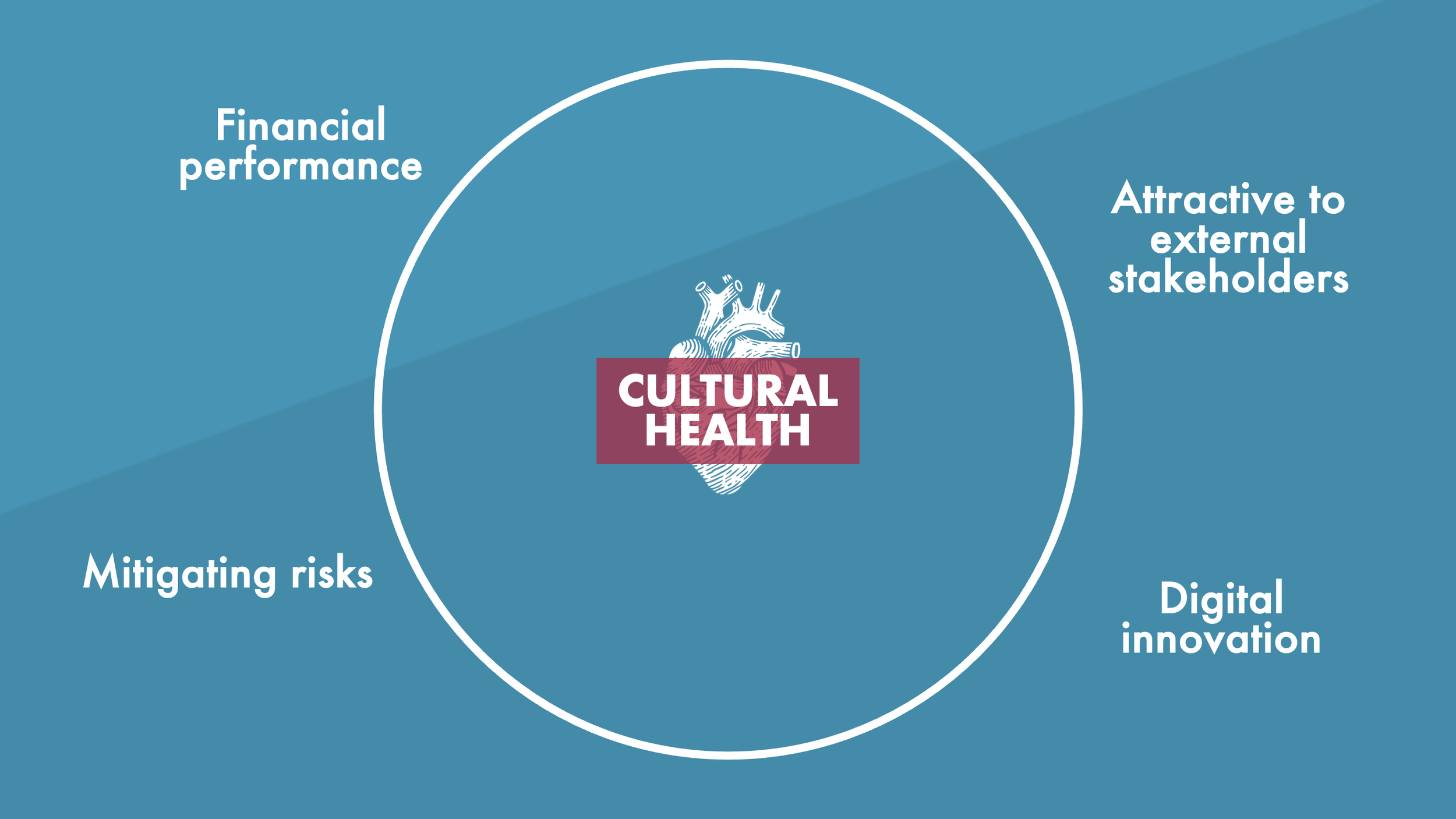
I discovered that while senior leaders are often rightly laser-focused on maximizing financial performance, driving technological innovation, being attractive to external stakeholders, and mitigating reputational risks, they often fail to give enough attention to the vital health of their culture even though, like our heart, it can help us thrive even in challenges or hinder us from achieving our most important objectives.
Considering the widespread prevalence and destructive consequences of cultural challenges, why do leaders often fail to deal with them before they have significant consequences?
To answer that, we’re going to take a quick look at three destructive yet common myths that leaders love to believe, even though they keep us blind and paralyzed.
-
Just as we often assume that our physical heart is healthy, we take for granted that we are a good organization with a healthy culture and great values. This makes us oblivious to the need to check our cultural health and leads us to use our values as a shield to protect against criticism. However, we are often not as values-driven as we want to assume.
-
When faced with symptoms of a lack of cultural health, there is a tendency to attribute the problem to one or a few difficult or destructive employees or a corrupt leader. This leads to an oversight of broader cultural challenges and a reluctance to take ownership. However, culture is always cocreated. There was someone who knew but didn’t speak up, or someone who was told but didn’t act.
-
When we see the need to address a lack of cultural health—often prompted by internal or external pressure—there is a tendency to relegate the issue to human resources (HR) or ethics and compliance. We expect them to initiate a short-term project: a new set of values, a training program, an employer branding initiative, or an event with an inspiring speaker. However, studies show that only 15 percent of these culture transformation initiatives succeed, often making a dark situation look even bleaker as fickle hope fades out.
A Radically More Effective Approach to Culture Change

While researching this book, I googled “the world’s healthiest person.” I was surprised that the top result featured a remarkably fit ninety-six-year-old man in a running shirt.
The late Mr. Charles Eugster was known as the world’s fittest pensioner before he passed away in 2017. At eighty-seven, he took up bodybuilding; at ninety-three, he took up sprinting and broke several world records.
So what was his secret?
Eugster told Vice magazine,
“You see, the stupid thing is that people don’t realize that you can have a beach body at ninety... I am living proof that, if you eat right and exercise properly, you can be that guy at any age.”
He also bragged about how seventy-year-old ladies on the beach would turn their heads when he passed by.
Eugster understood what is evident to us all—that sustainable habits, not short-term initiatives or Instagram posts from the gym, are the keys to physical health and a resilient heart. The same holds true for our cultural health.
Cultural health—which enables us to deliver on our mission and strategy, create a thriving workplace, and have a responsible impact—is not primarily built by short-term culture initiatives or events but by the everyday leadership habits that signal what is valued, rewarded, or disregarded in our team or organization.
To change our culture, we must make small but critical changes to what we repeatedly do instead of putting all our hope in occasional efforts.
When we, as leaders, are willing to begin by changing our habits and behaviors instead of deflecting blame, we can make a significant difference.
The Four Transfomative Habits of Responsible Leaders
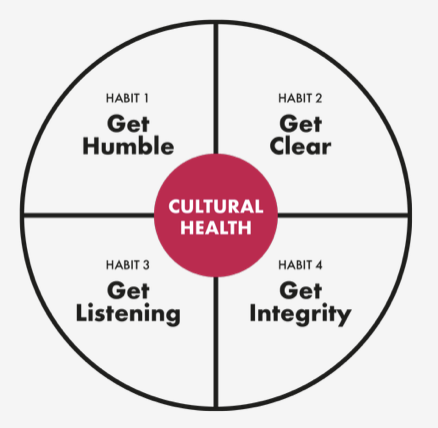
Through our work with hundreds of leaders in numerous organizations and extensive research over many years, we’ve discovered that, just like the heart has four chambers, there are four transformative habits and twelve practices for responsible leaders that will significantly impact the healthy of your culture.
They aren’t complex, but they are challenging. They will push your comfort zone, and you can’t relegate them to someone else. As a leader, you have to take responsibility and be the change. While the practical application and tactical incorporation may need to vary based on cultural and historical contexts, I am convinced that the habits are timeless and universally relevant to leaders across all contexts.
-
As leaders, we will, at times, realize that we have acted in conflict with our mission or values, become a part of hindering behavioral patterns, or begun to accept a lack of cultural health. When these issues are hidden, disregarded, or not dealt with consistently and urgently, there is a risk of breaking trust and impairing our ability to fulfill the mission, build a thriving workplace, and have a responsible impact. However, by embracing vulnerability, taking ownership, and actively working to repair broken trust, we can avoid pitfalls and transform our cultural health.
-
Many values statements are vague, disconnected from the mission, and seldom prioritized or consistently adhered to, leading to a lack of integrity and clarity around cultural priorities and hindering strategy execution. To build and sustain cultural health, we must clarify our most important values, celebrate the right behaviors, and deal with unhelpful or destructive behavior.
-
When team members don’t speak up or their voices go unheard, we lose critical insight into dilemmas, concerns, and opportunities for learning, improvement, and growth. As leaders, we often overestimate our listening ability and underestimate how hard it can be to give feedback or raise concerns. To break the silence, transform our cultural health, and avoid pitfalls, we must "get listening" by soliciting feedback, creating conditions for brave conversations, and exercising voicing our values.
-
Too often there’s conflict between the values we claim and the signals we send. We might, for example, say we want teamwork but incentivize only individual performance. To avoid mixed signals, we must ensure that the stories we tell, the rituals we design, and the processes and incentives we set embody our mission and values and sustain our cultural health.